Content note: mention of child abuse and executions.

The stone laid for Rebecca Nurse, as part of the memorial to the victims, at Salem.
Arthur Miller’s The Crucible has meant so much to so many people. As a parable about state control, or without its political dimension, as an examination of the power dynamics within a closed society, or of an individual working through guilt to find something valuable in themselves. I read it when I was fourteen and was rocked by the idea of someone feeling they were not worthy of the dignity of being hanged. I sobbed at the description of Giles Corey’s death, which is quite a thing to do standing in the school bus line. Its power came from this combination of events which I knew to be true and a personal psychology which I knew to be speculative, but felt convincing.
Miller made it clear that he saw the centralizing of public confession and the naming of names as the chief link between the witch and the McCarthy trials, along with their lack of a mechanism for someone who was not guilty to be recognised as such. However, what turned the parallel he saw into a great play was the invention of a highly personal drama taking place between a few emotionally involved people. To do this, he invented an entire ‘backstory’, and created a crisis that was theatrically appropriate, but not historically based. He was frank, but non-specific, about doing this. In the case of Abigail all he offered was “Abigail’s age has been raised”.
“Abigail’s age has been raised”, as if to change her from an eleven year-old child to an almost-adult above the age of consent is of little consequence. Yes, though the girl in the play is seventeen, the real Abigail was eleven. He could have added “and the suggestion of a sexual liaison between her and John Proctor is my own invention”. But he did not. He may not even have been wholly honest with himself about the genesis of this piece of the story resting entirely within his own mind.
When the film of The Crucible was released, Miller wrote an article for the New Yorker describing his process, more than forty years before, in researching for and writing the play. (Unfortunately the full text is not available without subscription.) When he wrote: “Elizabeth Proctor had been the orphaned Abigail’s mistress, and they had lived together in the same small house until Elizabeth fired the girl. By this time, I was sure, John Proctor had bedded Abigail, who had to be dismissed most likely to appease Elizabeth”, he did not make it clear that none of this comes from the historic record, and readers would most likely think he was expanding upon some actual primary-source material he quoted a line earlier. He may have forgotten himself where the line between fact and his imagination lay, but as he had shown himself to be aware that Abigail was eleven at the time it is disturbing enough that this is what he thought likely from the sixty-year-old Proctor. Let alone that he chose a word like ‘bedded’ instead of ‘raped’, which is what it would have been, except that it didn’t happen at all.
In changing Abigail’s age, Miller indicates his dissatisfaction with the truth of what took place as a story that would draw in an audience. As much as the play is about the McCarthy trials, its interest for the spectator lies more in the personal story that unfolds gradually, with a dramatic climax at the end of each scene. Miller’s instinct was that it was necessary to choose a woman whose culpability he could increase to get the narrative shape he needed. Abigail is not entirely without sympathetic moments, when she expresses her frustration with the hypocrisy and restrictiveness of her society, but spends much more time as the villain of the piece. The scene where she torments Mary until she recants is horrifying to watch. We are being shown virtuosic evil.
There is no record that suggests that Abigail ever was a servant in the Proctor household, and certainly no suggestion from anyone at the time that Proctor did anything improper with her. The court scene in which a desperate Proctor confesses his past sexual relationship with Abigail, and Elizabeth is brought in to confirm or deny it, is completely invented. This scene had to happen if Miller was to tell the story he wants to tell, but what implications does it carry for the material he is drawing upon? It tells us that he couldn’t write a good story about a man who was not struggling with some internal conflict, but it had to be one in which the audience would remain on his side. He could not bring himself to write a story without a woman who the audience can freely condemn. He must make what happened Abigail’s fault, and Elizabeth’s too, with her coldness, and her refusal to put out while suffering postnatal depression.
John Proctor was one of only a few male victims in a field made up almost entirely of women (there were six men and eleven women hanged, but also many more women than men imprisoned). As compelling as the story Miller wove from Proctor’s experience is, it is surely worth thinking about why none of these many women could form the core of his exploration. The first really big shock to the community would have been when Abigail Williams accused Rebecca Nurse, a highly respected member of the parish, instead of the misfits picked out at first. The Proctors came later, after John publicly expressed scepticism about the accusations. The person who made the most accusations, and the only one who later recanted, was Ann Putnam. The person who gave the most eloquent testimony, and presented the court with the most legally convincing petitions demonstrating the flaws of their process was Mary Easty. Why, even amidst events that mostly involved women, must the story be made to be about a man?
Are we seeing an instance of the woman of historic reality failing to fit into one of the few categories available for women in fictional narratives? An eleven year old child whose actions precipitated the murder of innocent people can be neither pure victim nor succubus. But shouldn’t this make her the most interesting character of all?
When Miller looked at the historic record, and thought about how he would turn it into an interesting enough story for a play, he felt it necessary to make the man more complicated than he (apparently) was, the woman more simple. A solid, respectable sixty-year-old man who was merely disgusted by the goings on or had no time for nonsense became a man tortured by the guilt of his adultery and the sense that he might have had some role in the harm happening to his wife. A child so messed up that we still have no real idea what could have brought her to do what she did becomes a femme fatale who wants to get her hooks into another woman’s husband.
Miller includes one later line relating to the real Abigail: “Legend has it that she later turned up as a prostitute in Boston.” In doing basic search-engine research, trying to establish where this ‘legend’ came from, I kept being returned to Miller’s own writing. No other source appears to exist. Did Miller simply make this up to give some vague sense of authenticity to the sexually immoral young woman that he himself had invented?
For those interested in what is known about the actual events surrounding the Salem witch trials, there is an archive and transcription of documents project underway. I found a terrific article by a historian in this field, Margo Burns, who also includes some great questions for students of the play that I hope many teachers are using. Miller’s changes have given her a similarly wrinkled brow to mine, but her concerns have a different emphasis.
Personally, I find the idea of little girls so psychologically destroyed by an upbringing that treated them as worthless that they would kill for the sake of some recognition pretty fascinating. Should someone choose, however, to put John Proctor at the centre of what happened at that time in that place, for the sake of making a larger political point, I wish it could be done without making him a child molester in order to make him a hero. In the end the playwright’s choices have led me to become less discomforted by Senator McCarthy’s weaknesses than Arthur Miller’s.
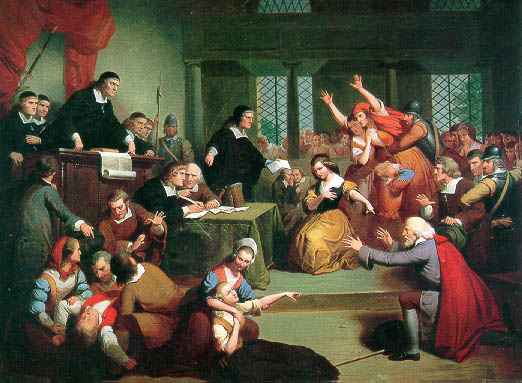
A nineteenth century painting depicting a scene in the Salem courtroom.
Categories: arts & entertainment, gender & feminism
 Wonder Woman movie marketing machine tied up in knots
  100 books by women in 2016
  2016 Hoydens: Debbie Reynolds and Carrie Fisher
  Podcast: “Decommodifying Feminism” Panel at #FWF16
  Hoyden About Town
I feel offended on behalf of the actual Abigail Williams, not so much for being fictionalised as a temptress but for having a lie told about her true fate. Miller’s Mary Magdelened her.
I’ve really been enjoying your recent posts, orlando! This was really interesting to think about, even though I’m not familiar with The Crucible, and your last few posts on Shakespeare have been fascinating as well.
I read it for school, but I think I need to read it again because a lot of the nuances you mention completely passed me by at 16. It is disappointing that Miller changed things so much; I think you are right Abigail has a fascinating story in her own right.
Thanks for this. When I read the Crucible for school I was really disturbed by Abigail’s age change but didn’t think about the history of the issue too much. Another example of women being written out of history.
This was fascinating Orlando. I performed in a production of The Crucible and studied at school and don’t remember being aware of the age change. Perhaps Miller just figured the audience wouldn’t be as interested in a female protagonist?
The Daniel Day-Lewis film comes to mind. It’s quite a different story when you age the hero up to 60 and the anti-heroine down to 11 eh?
I never liked the Crucible but never thought it through enough except to see it as a classic US cultural fudge where a potentially dissident critical political analysis had been somehow deflected into an individualistic personal drama. Your analysis is excellent.
You write so beautifully Orlando! Like Mindy, I studied the play at high school but failed to pick up on the age difference. I greatly enjoyed an article, I think it was in Scientific American, which claimed that ergotism (a fungal disease of rye endemic to low lying areas) was so rife in Salem that they were prettywell tripping off their faces. Add to that a genuine belief in the supernatural and you would need no real motive to denounce someone as a devil or witch. Not sure how much credence that theory has these days!
Yes I remember the rye idea. That combined with sexual repression was thought to be the stimulus for the whole thing. Shame so many people had to die horribly.
Thanks for this post, Orlando. I studied the Crucible in high school and loved it at the time, but found Miller’s version of Abigail jarring for reasons that I couldn’t quite put my finger on. What you’ve said here goes a long way to explaining the reasons for my unease. It’s a classic one-two move, really, isn’t it? Sexualise a woman/girl, and then demonise her for her sexuality.
It’s also saddening to see Miller use allegations of sex work to further cast aspersions on Abigail. The rubric, of course, being one where “sex worker” equals “bad or untrustworthy person”. Sigh.
Thanks for all these considered responses, everyone. Ian, probably because I have a tendency to look at everything with a director’s eye, it never occurred to me that locating the plot around the psychology of an individual was a flaw in and of itself, but I see your point.
Re. the ergotism theory, Skeptical Humanities has a very entertaining look at why it is unlikely. The same article includes what I think is a very important line when thinking about how something like this could have happened: “it is also apparent that the forces that initiated the craze were not the same ones that perpetuated it.”
I don’t know what influenced Miller, but there is a large historiography on the psychology of witchcraft and much of it emphasises that the supernatural provides an explanatory language for dealing with the unspeakable (aka sex). Through this reading, accounts of supernatural events, not just witches, but ghosts, fairies etc, are actually ways of speaking incest, sexual abuse and rape, and homosexual desire and acts, within a context where communities don’t have a language to speak about these things, or alternatively, where the official discourses around sex lead to social and physical penalties (sometimes literally the death penalty)that are discomforting to community norms (ie many communities disaproved of sodomy, but weren’t prepared to send their members to be executed for it). As a result, witchcraft trials are ‘read’ as ways for communities to negotiate norms in sexual and other ‘taboo’ areas.
Some of the evidence for this is really very convincing and it may certainly be true in individual cases. But, I think this discounts the importance of the imagined to shaping people’s worlds, through assuming that seemingly ‘ridiculous’ (to the modern eye) claims and events must either be ‘lies’, hallucinations or mental illness, or a code for something ‘realistic’ below the linguistic surface. I think this might be a disservice to the complexity and pervasiveness of early modern belief systems around the supernatural.
I also agree that putting the individual psychological drama at the heart of the witchcraft trial drama is slightly problematic, as witchcraft accusations were made fairly regularly. It’s only at particular historical moments that they are taken seriously enough to warrant trials and investigation, and if we want an explanation for the trials then we need to understand the bigger group dynamic or social context.
I agree completely with this, right up until you say “early modern belief systems around the supernatural.”
The word supernatural wasn’t even coined until the 15th century, and I’d strongly suggest that people didn’t think of witches, goblins, giants etc as “super” natural, rather as part of the natural world. Once the term supernatural was in use, in the later middle ages and up until quite recently, it wasn’t used to describe the things we think of as supernatural either – it meant ‘Of or given by God, divine; heavenly.’
Basically, the concept didn’t exist (at least in English-speaking culture). The contemporary idea that when people in the middle ages or early modern world (up until probably the Romantic period) wrote about such things they were essentially writing fiction is nonsense.
I may be nitpicking about words (this would not be unusual for me!), but words are concepts and the English medieval world view was the focus of my Masters, so I get a bit riled up about it!
To be honest,I was using supernatural as a modern catch-all for this sort of phenomenon, rather than as a contemporary term. But, the Salem witch trials were in 1692, by which point ‘supernatural’ was used quite regularly in published philosophical works and sermons in Western Europe, which suggests that it was a significant concept to them (if perhaps holding a slightly different resonance than today). Indeed, witchcraft itself is an early modern phenomenon and can be seen as part of a belief structure tied into a broader philosophical discourse around the ‘supernatural’ that is being developed during the period; there are few cases before the late 16thC and it wasn’t even an offence until the late 14thC. By 1692 when the Salem trials were carried out, many people no longer believed in witchcraft and thought it was fantasy on the part of those who claimed to be witches. Forty years later, in England, parliament would pass an act not only removing witchcraft from the statute books, but making it illegal to claim that anybody held supernatural powers. Other parts of Europe and the US (that tended to follow UK law) made steps in a similar direction around the same time. So, many historians have seen these later trials as key moments in move to modernity, reflecting a last gasp of old beliefs as we moved to modern rationalism (although this has been downplayed in more recent interpretations).
FA, I’m just excited to see someone using the word ‘contemporary’ in the sense I use it.
For those not down with the jargon, ‘early modern’ is the term most often used these days for the period between medieval and when the Enlightenment kicked in in the 18th century. Renaissance used to be used, but then it was argued that that term should apply specifically to Italy. In British history it means roughy Tudor to Restoration.
The significance here, as both Rebekka and FA have touched on, is that the Salem witch trials happened late in the wider story, after the European witch hunts had more or less extinguished themselves. It suggests that the social environment in the New England colonies must have had some distinctive features that I wish we had the means to examine.
Well, there are other contemporary 😉 European examples as well, so 109 people are executed in Salzburg, Austria in 1681; 71 executed on a single day in Torsaker in Sweden in 1675, and a very similar case to Salem happened in Paisley, Scotland, leading to the death of 7 people in 1697. And, all over Europe, there are individual witches tried periodically in the early 18thC. But, the bulk of the deaths arising from the ‘witch craze’ happened between 1580 and 1630 in Europe, so even given these numbers these cases are seen as outliers to the bigger picture. Why they happened, or rather why these particular claims by these particular people were taken so seriously, is a question of considerable debate!