Because without them we wouldn’t have seasons. Happy September equinox, all.
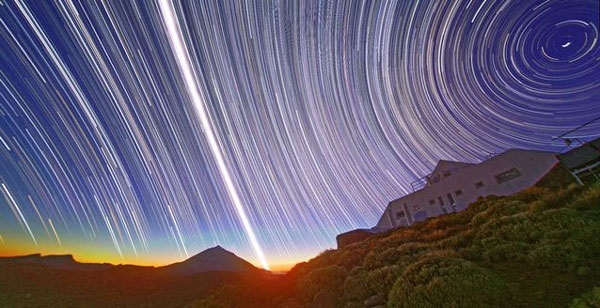
This picture combines daytime and night-time photography and uses the equatorial location to show both northern and southern hemispheres of the sky together. | Image credit: Juan Carlos Casado
Equinoxes occur when the Sun as viewed from Earth crosses the celestial equator, marking the astronomical change of seasons to longer thus warmer days in one hemisphere and shorter thus colder days in the other. The word equinox means equal night, because around the equinoxes we experience nearly 12 hours of sunlight and 12 hours of darkness.
Saturn only has an equinox every 15 years, because it’s orbital period is so much longer than Earth’s. When Saturn is at equinox, the rings disappear for observers on Earth, because they are directly edge-on to the Sun and thus very nearly edge-on to the Earth. My favourite spacecraft, Cassini, took this photograph of Saturn at equinox back in 2009.

Saturn at Equinox | Credit: Cassini Imaging Team, ISS, JPL, ESA, NASA
 In praise of Applied Chemistry and Basic Hazard Management
  So that’s why I haven’t been writing much lately
  Happy Epic Pi Day
  December Solstice
  Hoyden About Town
Lovely photos. Some people in parts of the world with more extreme climates might disagree with you though 🙂
Nitpick: how can the upper photo(s) possibly have been taken on the equator, with a celestial pole visible that far above the horizon?
(Based on the bright star visible so close to that pole, it must be the north pole, and so the photo(s) must have been taken in the northern hemisphere. I’d guess between 10 and 20 degrees north latitude?)
I think you’re overthinking it, AotQ – the north celestial pole (or at least the stars that appear to orbit around it from our perspective) is so many millions of miles away from our planet that it’s visible from any point on the equator where you have a clear line of sight to the horizon. On top of a mountain with a wide angle lens it’s perfectly possible to see the ecliptic and the pole in the same shot.
If this seems counter-intuitive, imagine a spinning basketball to represent the earth and a bright light several miles away in line with the axis of rotation. A camera placed on the ‘equator’ would be able to ‘see’ the light unless it was actually buried in the surface of the basketball. In fact, with a 180 degree ‘fish eye’ lens you could photograph the ecliptic and *both* celestial poles simultaneously, provided there was no higher mountain in the way.
Ooh, via Bad Astronomy Blog: a video showing A Year Of Sunrises
https://www.youtube.com/embed/qZArJaUZNek?version=3&rel=1&fs=1&showsearch=0&showinfo=1&iv_load_policy=1&wmode=transparent
My turn to nitpick.
This makes it seemingly hover over a single point on the Earth (though it really is in orbit)
Is there a difference? Isn’t my house in a very, very very low geosynchronous orbit?
Hm, verrrrry nice nitpicking.
Methinks however that for one object to orbit another object there does actually have to be some proper space-space in between, not just layers of various substances.
If Occam’s razor is half an atom wide, does that count, or should I get some angels to lift it instead of doing the macarena all over the sewing box?
the macarena??!!? Pfffft.
If those angels can’t at least manage the complexity of The Hustle, I don’t think they’re senior enough to count.
DISCLAIMER: I don’t know how to phrase the below politely, so it doesn’t come across as aggressive. I am not trying to offend or hurt, but I do know a bit about how stars appear in the sky and I am not going to be quiet when something that objective is under dispute.
So sure, the celestial poles are visible from the equator, but they are right on the horizon, not as far above the horizon as in the photo. You cannot get on a high enough mountain to overcome that; besides, that photo looks like it was possily shot in a valley, looking up at the building on the right.
A bit of internet searching reveals that the photographer says the photo was taken in the Canary Islands, at 28N, even further north than I guessed.
AotQ, I’m not offended and I appreciate the new information. The site where I found the photograph claimed that it was taken in Ecuador, but your cite seems much more authoritative.
I did check a few star charts and discuss the photo with my more-astronomically-knowledgeable-than-I-am spouse, but I guess that I was so accepting of the information I had that it was taken in Ecuador that I bent my explanatory powers to fit that scenario. Too damn easy a trap to fall into, that one. My apologies for leading folks down the garden path.
Since we’re nitpicking – “Saturn only has an equinox every 15 years, because it’s orbital period is so much longer than Earth’s”
“…it’s orbital period…” shouldn’t have an apostrophe – it’s = it is.
🙂
@Rebekka, Oh noes, I didn’t! Oh bugger: yes I did.
THE SHAME.
It appears to be not my week 🙂
We’ll call it a typo, and say no more about it.
O/T
@Rebekka That one catches me out all the time. Good thing I don’t do proof reading for a job. It must get irritating though.
@Tigtog: Bob Geldof said ‘sentient’ when talking about people last night. I eyerolled on your behalf. /OT
Enjoying the equinox at the moment, although getting the chookies to go to bed is a bit of a bother. Usual tricks of luring them in with food aren’t working because three go in, eat their fill and wander back out again while I’m trying to get the recalcitrant two in. Rinse, repeat. Then walk off in disgust and only remember right on dark that they haven’t been locked away.